How to Maximize Michaels Coupons In Store for Big Crafting Savings
Craft stores have a clever way of making a deal look bigger than it really is. A regular-price item can sit at a relatively high shelf price, then suddenly look like a bargain once a 30% or 40% discount appears. That pricing rhythm can make shoppers focus on the percentage instead of the final amount they actually pay. The smarter move is to check the item, the offer, and the exclusions before reaching the register. That is where michaels coupons in store become useful, especially when the goal is to turn a genuine discount into a real saving rather than a flashy percentage.
Michaels currently says its coupons are available through its website, mobile app, direct mail, email, and SMS programs rather than being distributed directly inside stores. Its current policy also limits shoppers to one coupon per product and one coupon of each type per day, while exclusions can remove a surprisingly large number of popular craft categories from the deal.
The practical lesson is simple. Do the coupon audit before checkout, not while the cashier is already waiting.
Michaels Coupons In Store Start With the Right Regular Price Item
The best use of a percentage coupon is usually not the cheapest item in the cart. It is a qualifying regular-price item with a meaningful ticket price that is not already receiving a better promotion.
A 40% discount on a $5 item saves only $2. On a $25 qualifying item, the same percentage saves $10. That difference matters when a crafting project requires several purchases.
| Regular Price | 30% Off | 40% Off | Savings Difference |
| $5 | $3.50 | $3.00 | $0.50 |
| $10 | $7.00 | $6.00 | $1.00 |
| $15 | $10.50 | $9.00 | $1.50 |
| $20 | $14.00 | $12.00 | $2.00 |
| $25 | $17.50 | $15.00 | $2.50 |
| $40 | $28.00 | $24.00 | $4.00 |
These numbers show why the percentage alone is not enough. A bigger discount on a small purchase can save less money than a smaller discount on a higher-priced qualifying item.
Michaels also states that promotional and sale items are excluded from certain regular-price coupons. Clearance is excluded as well, along with many branded and service categories.
Recollections Supplies Can Make a Better Coupon Target
Regular-price crafting basics can be strong coupon candidates when they qualify. Recollections products, Make Market supplies, storage items, paper crafting tools, and similar project materials can become more worthwhile targets when their regular price is high enough to make the percentage meaningful.
The key is checking the current product status rather than assuming a familiar brand always qualifies. Michaels product pages can show whether an item is in-store only, on clearance, or already under another promotion. A recent Michaels listing for a Recollections adhesive runner, for example, showed a clearance price while also displaying coupon language, demonstrating why the product status and current offer need to be read together rather than judged from one promotional message.
The $25 Purchase Shows Why Coupon Math Matters
A shopper choosing between several $5 supplies and one $25 qualifying tool can see a very different result.
A 40% discount on the $25 item produces $10 in savings. Applying the same percentage to one $5 item produces only $2 in savings. If the smaller supplies are already on sale, the higher-value regular-price item becomes even more attractive as the coupon target.
This is the basic barcode audit. Scan the item, confirm the regular price, check whether another promotion is already reducing it, then see whether the coupon applies.
A Regular Price Tag Does Not Guarantee Coupon Eligibility
A regular price is only one part of the equation. Brand exclusions, product categories, offer restrictions, and the wording of the current coupon can still stop the discount.
Michaels lists Cricut, Glowforge, Silhouette, Brother, Singer, Creality, Kodak, Lego, Pokémon Trading Cards, Gildan, custom framing, gift cards, classes, and several other categories among its exclusions, with the list subject to change.
That makes the product page and the current coupon terms more reliable than an old coupon screenshot or a memory of a previous promotion.
Printable Craft Coupons Need a Barcode Audit Before Checkout
Printable craft coupons are no longer the only practical route to a Michaels discount. The retailer says coupons can come through several digital channels, including its website and mobile app, while direct mail remains another source.
For an in-store shopper, the important part is making sure the offer is actually intended for store use.
The most common mistake is treating every percentage-off promotion as interchangeable. A 40% offer can look perfect on a phone screen and still be marked online only. Michaels employees have described real checkout situations where customers brought online-only offers to physical registers, only to discover that the promotion did not apply.
Read the Offer Type Before Showing the Barcode
An offer designed for an online transaction is not automatically an in-store coupon. The wording matters more than the percentage.
Before leaving for the store, check:
- The offer’s valid dates
- The intended shopping channel
- The minimum purchase requirement when applicable
- The product exclusions
- The coupon type
- The number of eligible uses
- Whether the item is already discounted
This takes less time than troubleshooting a failed discount at the register.
Screenshots Create Another Layer of Confusion
Coupon screenshots have also caused problems in physical stores. Michaels employee discussions have described changes around accepting screenshots and repeated use of the same coupon image.
The safer approach is to open the current offer from the official Michaels source rather than relying on an old screenshot saved in the phone gallery.
The same principle applies to expired social media posts. A coupon circulating in a crafting group can look legitimate while no longer being active.
Barcode Scanning Can Fail Even When the Coupon Looks Correct
Barcode scanning is not simply a matter of presenting any visible code to the register. The offer still has to match the transaction rules.
Employee reports also document occasions when an otherwise valid-looking coupon failed at both regular registers and self-checkout, showing that a failed scan does not automatically prove the shopper selected the wrong product.
That is why the most useful response to a failed scan is to check the offer details, item eligibility, and current system status instead of immediately assuming the cashier caused the problem.
Michaels Exclusion List Decides Which Crafting Deals Survive the Scanner
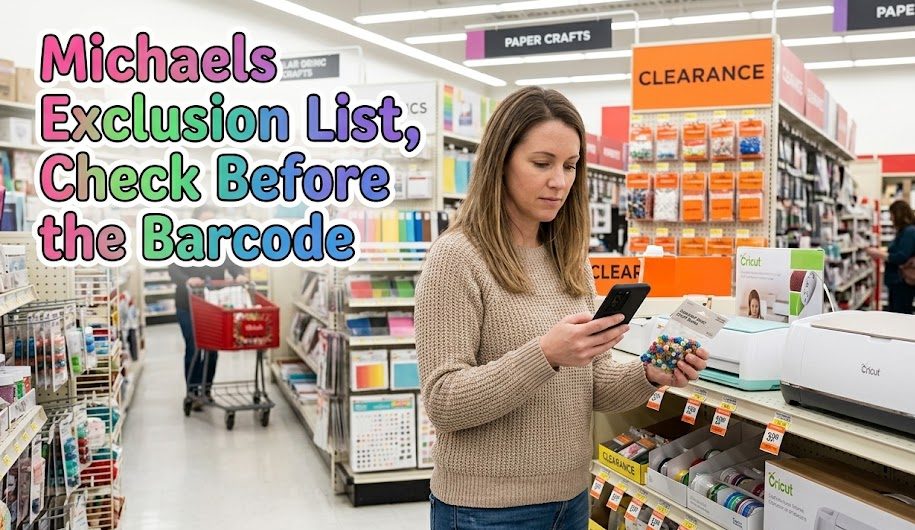
The exclusion list is the part many shoppers skip, and it is also where the biggest checkout surprises happen.
Michaels’ current policy excludes categories including clearance, MichaelsPro Packs, Artist’s Loft Super Value Canvas Packs, custom framing, Michaels Photo Gifts, beverages and candy, books and magazines, rolled posters, classes, birthday parties and private events, cut-to-order fabric, gift cards, several craft technology brands, balloons, and various branded products. The retailer notes that exclusions are subject to change.
That list means the ideal coupon target is not necessarily the product that feels most expensive or exciting.
Cricut and Other Craft Machines Belong on the Exclusion Check
Cricut, Glowforge, Silhouette, Brother, Singer, and Creality appear among the current exclusions for regular-price coupon offers.
This matters because craft machines can carry much higher prices than everyday supplies. A shopper may see a $300 machine and mentally calculate a large percentage discount, only to discover that the category is excluded.
The smarter move is checking eligibility before building the shopping plan around the discount.
Clearance Can Beat a Coupon Without Accepting the Coupon
A clearance item priced at $6 may be a better purchase than a $10 regular-price item reduced by 30%.
The calculation is straightforward. The discounted regular-price item would cost $7 after 30% off, while the clearance item costs $6 before any coupon. Since clearance is generally excluded from the regular-price coupon structure, the cheaper shelf price can still win.
This is where the supposed coupon savings can become an illusion. The final price matters more than the promotional percentage.
Books, Classes, Framing, and Services Need Separate Treatment
Not every Michaels purchase behaves like a normal craft supply. Books and magazines, custom framing, classes, parties, and other services appear within the exclusions listed by Michaels.
These categories should be evaluated through their own promotions rather than forcing a standard percentage coupon into the transaction.
Third-Party Marketplace Items Need Extra Attention
Michaels also excludes Michaels.com and MakerPlace products sold and shipped by third-party sellers from the listed coupon structure.
That distinction matters because the product can appear on the Michaels website while still being outside the standard coupon rules. Seeing the Michaels brand around a listing does not automatically mean the item qualifies for an in-store promotion.
Physical Store Discounts Work Best When Coupon Math Meets Price Matching
Physical store discounts should be viewed as one part of the savings strategy rather than the entire strategy.
Michaels currently offers an in-store price guarantee for qualifying identical items advertised on Michaels.com, subject to its stated restrictions. The shopper must tell a team member about the price at checkout, and the identical item must be in stock and available to purchase on Michaels.com.
The retailer also says competitor price matching is not part of its current U.S. in-store guarantee on the same basis described for Michaels.com pricing.
Compare the Final Price Instead of Chasing the Highest Percentage
Imagine a $30 regular-price item with a 30% coupon.
The coupon price is $21.
Now imagine the same product is currently listed online at Michaels for $18 and qualifies for the in-store price guarantee. A $21 coupon price would be worse than an eligible $18 price match.
The lesson is useful because shoppers can become too focused on finding a coupon when the better deal is already sitting in the retailer’s own pricing system.
One Coupon Per Product Changes How a Larger Cart Should Be Planned
Michaels states that its coupon policy limits one coupon per product and one coupon of each type per day.
For a larger crafting haul, this means the cart should be reviewed item by item. Do not assume that one coupon will reduce every product in the basket.
A practical pre-check can look like this:
- Remove clearance items from the coupon calculation.
- Separate sale items from regular-price items.
- Identify excluded brands and categories.
- Compare the remaining regular-price items by dollar value.
- Apply the available coupon to the strongest qualifying target.
- Compare the resulting price against any available Michaels online price.
That process takes the emotion out of the checkout decision.
The Barcode Is the Final Reality Check
A coupon can look perfect on the phone and still fail because the item is excluded, the offer is expired, the offer is online only, or the transaction does not meet its conditions.
Michaels itself advises shoppers to verify valid dates, enter codes correctly where applicable, and confirm that items are not excluded. It also states that third-party promo codes are not honored.
For shoppers trying to avoid wasted money, the barcode audit is therefore simple. Verify the offer, verify the item, verify the price, then scan.
Q&A
Can an Online-Only Michaels Coupon Be Used at a Physical Register
No. An offer marked online only should be treated as an online promotion rather than an in-store discount. Employee reports from Michaels stores show that customers regularly encounter this distinction at checkout.
Why Does a Michaels Coupon Barcode Sometimes Refuse to Scan
A failed scan can result from an excluded item, an expired offer, an online-only promotion, a technical register issue, or another condition in the coupon terms. Employee reports show that system-wide scanning problems can also happen, so a failed scan alone does not identify the cause.
Is a 40% Coupon Always Better Than a Sale Price
No. A sale or clearance price can produce a lower final cost than applying a percentage coupon to a higher regular price, and Michaels excludes clearance from its listed regular-price coupon structure.
The strongest Michaels savings strategy is therefore not simply collecting the biggest percentage. It is choosing a qualifying item, checking the current exclusion rules, comparing the final price, and using the offer only when the numbers actually work.




Leave a Reply