Discovering Hidden Amazon Coupons on the Secret Outlet Page
There is a certain kind of Amazon shopper who sees a price, hits Buy Now, and never looks at the rest of the page. That is convenient, but it can also mean leaving perfectly legitimate savings untouched. amazon coupons are not always presented in the same place, and the better strategy is to look beyond the standard product page and check Amazon’s deal-focused sections before paying full price.
The idea of a completely secret Amazon page needs a little reality check, though. Amazon does have an Outlet section for overstock and clearance merchandise, while coupons can appear on product pages, in search results, on the Deals page, and around products already sitting in a shopper’s cart. Amazon itself describes coupons as discounts that customers can clip or redeem with a code.
So the real “loophole” is not a hidden hack that bypasses Amazon pricing. It is knowing where discounted inventory and coupons overlap.
1. Amazon Coupons And Overstock Deals Start With The Outlet Trail

Amazon Outlet is designed around markdowns, overstock inventory, and clearance merchandise. Amazon describes Outlet as a destination for discounted products across categories including electronics, toys, beauty, kitchen, automotive, and more.
That makes Outlet the first place worth checking when the goal is to buy something cheaper rather than simply hunt for a generic coupon.
Start With Amazon Outlet Instead Of Random Coupon Searches
The basic navigation is simple. Open Amazon, go to the Deals area, and look for the Outlet or clearance-focused shopping sections available to the account and marketplace.
The exact interface can change, so old screenshots showing a particular button or menu should not be treated as permanent instructions. Amazon frequently adjusts its shopping interface and promotional placement.
The important part is the destination rather than memorizing one visual path.
Overstock Deals Are About Inventory Age
Amazon’s seller documentation explains that Outlet is connected to excess and aged inventory. Products recommended for Outlet can be evaluated using factors such as customer demand and inventory age.
That explains why Outlet can contain surprisingly good prices on products that are not necessarily damaged or unpopular.
For shoppers, this creates a useful distinction. An Outlet item is not automatically equivalent to a used item. Amazon’s seller guidance says eligible Outlet inventory is generally required to be in new condition, although the exact eligibility requirements can change.
Look For A Coupon After Finding The Discounted Product
This is where the strategy gets interesting.
Do not assume the Outlet price is the end of the calculation. Open the product listing and look for an available coupon. Amazon says coupons can appear directly on product detail pages, search results, the Deals page, and products already added to a cart.
If an Outlet product also carries a coupon, the two discounts may potentially work together.
Amazon’s seller documentation explicitly states that Outlet deals can combine with coupons and other promotions running on the same product.
That is much more useful than chasing a mysterious universal coupon code.
The Checkbox Is The Part Shoppers Commonly Miss
The familiar coupon mechanism is the small “clip coupon” control displayed around eligible listings. Amazon’s own advertising documentation confirms that shoppers can click a coupon placement to clip the offer and reach the relevant promotion shopping page.
Depending on the current interface, the control may look like a checkbox or a simple coupon button rather than a traditional promo-code field.
The practical sequence is therefore:
- Find the Outlet or clearance item.
- Open the full product listing.
- Check whether a coupon is displayed.
- Clip the coupon when available.
- Add the item to the cart.
- Confirm the discount appears before completing payment.
The key is that the discount must actually appear in the cart. A green coupon label or promotional message is not enough by itself.
2. Warehouse Savings And Checkbox Discounts Need A Different Reality Check

Warehouse shopping is another route to lower Amazon prices, but it should not be confused with Outlet.
Amazon Outlet focuses on discounted new inventory and excess stock, while Amazon Warehouse has historically been associated with returned, open-box, and used products whose condition is disclosed on the listing. The important takeaway is that shoppers should inspect the condition description instead of treating every discounted Amazon item as equivalent.
That is where warehouse savings can become valuable, particularly when cosmetic packaging damage does not matter.
The savings calculation should include more than the percentage shown beside the item.
Check the actual condition, seller, return eligibility, included accessories, and final checkout price. A 35% reduction is not necessarily a bargain if the product is missing an important component or the new version is only slightly more expensive.
The same discipline applies to checkbox discounts. A coupon is only useful if it actually attaches to the eligible product and survives through checkout.
Amazon says coupons are limited-time offers and can have usage restrictions determined by the seller.
That means an old coupon screenshot, a coupon code from a forum, or a search result mentioning a discount does not prove that the offer is active today.
For practical shopping, the strongest evidence is the live listing and the final cart.
A useful review method is to compare four figures before buying:
- Current selling price
- Outlet or sale reduction
- Coupon reduction
- Final checkout price
This prevents the classic mistake of mentally adding discounts that never actually apply.
There is also an important mathematical detail. Amazon’s seller documentation gives an example where a $100 Outlet deal discounted by 50% combined with a 5% coupon produces $55 in total savings, leaving a $45 price.
That is different from applying 50% and then another 5% to the already discounted $50. The exact calculation depends on how the promotions are configured.
For shoppers, the safest rule is simple: trust the final cart rather than calculating a theoretical stack from the percentages shown on separate screens.
This is especially important because Amazon says different promotion types can combine, but individual offers can have their own conditions. Amazon’s seller guidance confirms that percentage-off and money-off coupons may combine with promotions, sale prices, business prices, and Outlet deals.
The experience of using these deals is therefore less about finding one magic code and more about checking whether the discounts coexist on the exact ASIN being purchased.
If you already use stacking strategies at other retailers, the same principle applies to CVS coupons and ExtraBucks. The retailer’s own rules matter more than generic coupon advice.
3. The Hidden Promo Section Is Really A Navigation And Verification Game
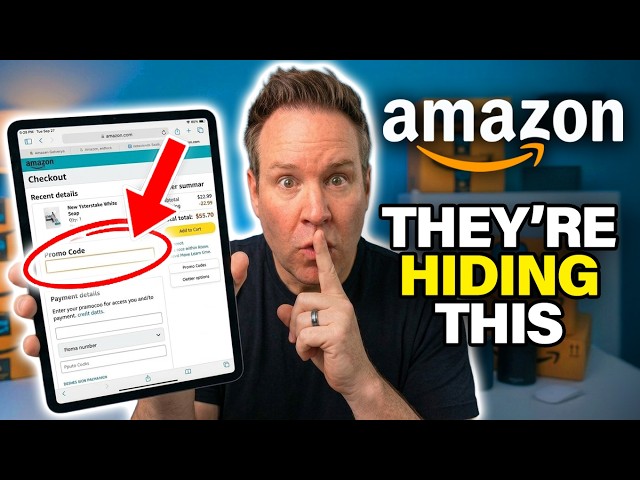
The most useful conclusion from researching Amazon’s current coupon and Outlet system is that there is no single secret page that guarantees an extra discount on every product.
The better method is a three-stage search.
First, search for discounted inventory. Outlet is useful for overstock and clearance products, while Warehouse can be relevant when open-box or used-condition merchandise is acceptable.
Second, inspect the product page. Amazon says coupons can appear on product detail pages, search results, the Deals page, and carts.
Third, verify the checkout. If the coupon has been clipped correctly, the savings should be reflected in the purchase calculation.
This makes the so-called hidden promo section less mysterious. Amazon does not necessarily hide a universal discount behind a secret button. Instead, promotions are distributed across different shopping surfaces and can vary by product.
That variability is actually useful for bargain hunting.
A product with a normal price may have no coupon. The same category may contain an Outlet item with a markdown and a coupon. Another item may have a sale price but no coupon. The best deal comes from comparing the final prices rather than assuming the biggest percentage is automatically the winner.
Amazon also confirms that coupons are time-limited.
That means a good deal can disappear without warning, especially when the seller’s coupon budget or promotional period ends. Amazon’s seller guidance explains that coupons can be taken offline after reaching a set budget, with a remaining redemption window for customers who have already clipped the offer.
For shoppers, this creates one more reason not to rely on stale coupon pages.
A strong Amazon deal workflow looks like this:
- Search the desired product normally.
- Compare the standard listing against Outlet and clearance alternatives.
- Check the product page for an available coupon.
- Clip the coupon when the offer is genuinely displayed.
- Compare the final price against competing listings.
- Review condition and seller information before purchasing.
- Confirm the discount in the cart.
The biggest recommendation is to avoid buying something merely because the discount looks dramatic.
A 40% coupon on a $30 product saves $12. A 20% discount on a $100 product saves $20. The percentage alone does not determine the better purchase.
There is also no reason to treat Outlet as a suspicious backdoor. Amazon itself promotes Outlet as a place for customers to find overstock and clearance products.
The useful part of the strategy is simply knowing that Amazon’s shopping ecosystem has several layers. Standard listings, deals, coupons, Outlet inventory, and Warehouse-condition products can produce very different final prices.
That is why the best Amazon bargain hunters behave more like price researchers than impulse shoppers. They check the product, inspect the promotion, and only then decide whether the final number deserves the Buy Now button.
In short, amazon coupons are most valuable when they are combined with smart product discovery rather than used as an excuse to purchase something unnecessary. The Outlet route can uncover legitimate markdowns, and a visible coupon can sometimes push the final price even lower. The winning move is not finding a secret Amazon loophole. It is learning where Amazon places its legitimate discounts and verifying the math before paying.
Q&A
Does Amazon Outlet Always Have Coupons Available?
No. Outlet is primarily a destination for discounted and excess inventory. A coupon is a separate promotion and only appears when the specific product has an active eligible offer. Amazon states that coupons are available only for selected products and for limited periods.
Can An Amazon Coupon Combine With An Outlet Discount?
Amazon’s seller documentation says Outlet deals can combine with coupons and other promotions running on the same product. The exact result depends on the individual promotion setup, so the final cart price should always be checked before payment.
Is An Outlet Product The Same As An Amazon Warehouse Product?
No. Amazon Outlet is primarily associated with discounted overstock and clearance inventory, while Warehouse listings are associated with products sold in conditions such as used or open-box. The condition and listing details should be reviewed separately before purchasing.





Leave a Reply