The Exact Method to Stack Extrabucks and CVS Coupons Successfully
That almost one-meter-long CVS receipt can look like a random wall of tiny numbers, discount codes, offers, and savings lines. The trick is to stop treating it as disposable paper. With the right cvs coupons strategy, those numbers can reveal where the real savings came from, which rewards came back, and how much you can reduce on the next transaction. The system looks complicated at first, but the underlying math is surprisingly straightforward once each discount is assigned to the right place.
CVS officially allows customers to combine certain CVS-issued coupons with valid manufacturer coupons, while ExtraBucks Rewards can generally be applied toward the remaining cost. The important detail is that CVS reserves the right to determine processing order, so the popular idea that every transaction must always scan in one fixed sequence is better understood as a practical couponing method rather than an absolute CVS guarantee.
The goal is not to throw every coupon into one basket and hope the register accepts everything. The smarter approach is to build the transaction around the promotion, identify which coupon attaches to which item, and calculate the final out-of-pocket cost before reaching checkout.
1. CVS Coupons And The Real Math Behind Extrabucks Rewards
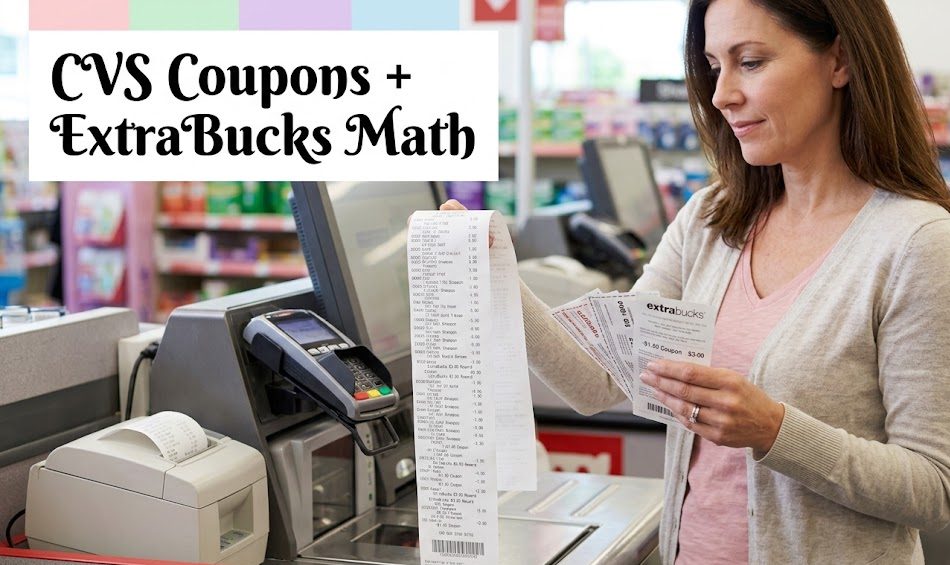
The strongest coupon transactions usually have three layers. There is the store promotion, a qualifying manufacturer coupon, and a CVS-issued discount or ExtraBucks reward. CVS confirms that a manufacturer coupon and a CVS coupon can be used on the same qualifying item, while ExtraBucks can be used toward the final cost as long as the purchase has not already been reduced to zero by other coupons.
That creates a simple framework for understanding the transaction.
| Layer | What It Does | Example |
| Sale price | Lowers the starting price | $10.00 → $8.00 |
| Manufacturer coupon | Reduces the qualifying item | $8.00 → $5.00 |
| CVS coupon | Adds another eligible discount | $5.00 → $2.00 |
| ExtraBucks | Reduces remaining payable amount | $2.00 → $0 or near $0 |
The numbers above are only an illustration. Actual offers depend on the product, promotion, coupon restrictions, and the ExtraCare account being used.
Manufacturer Codes Come First In The Practical Stack
Manufacturer codes identify a coupon as being funded by the product manufacturer rather than CVS. CVS states that only one manufacturer coupon may normally be used per qualifying item unless the coupon itself says otherwise.
This distinction matters because two coupons that look similar may not belong to the same category. A $3 manufacturer coupon and a $3 CVS coupon can potentially work together. Two separate manufacturer coupons generally cannot be stacked on one item.
For shoppers building a transaction manually, the first step is therefore matching every manufacturer coupon to a specific qualifying product.
Extreme Couponing Logic Starts With The Promotion
The biggest mistake in extreme couponing logic is starting with coupons instead of the deal.
A better sequence is promotion first, product second, coupon third, reward last.
Suppose a product is advertised at $6 and generates $2 in ExtraBucks. A $2 manufacturer coupon potentially changes the immediate cost to $4. If the $2 reward is earned after the qualifying purchase, the effective cost becomes $2 after the reward is received.
That is different from saying the cashier instantly charged only $2. The receipt may still show a $4 immediate payment before the reward is issued.
This distinction is one of the most useful pieces of drugstore savings math because it separates cash paid today from rewards available for the next purchase.
Why The Receipt Matters More Than The Shelf Tag
The receipt provides the transaction audit trail.
It can show the original item price, sale adjustment, CVS coupon, manufacturer coupon, ExtraBucks redemption, and the savings total. CVS also states that digital ExtraCare coupons can be sent to the ExtraCare card through CVS.com, the CVS app, digital receipts, or CVS emails.
If a transaction looks different from the planned calculation, the receipt makes it easier to determine whether the problem came from an ineligible item, an expired coupon, an offer restriction, or a reward that was expected but not actually earned.
ExtraBucks Are Not The Same As Instant Discounts
ExtraBucks rewards deserve their own category because they are rewards rather than ordinary price reductions.
CVS describes ExtraBucks as part of its ExtraCare rewards system and states that qualifying rewards can be earned through advertised offers and other eligible activities.
That means a transaction can have a higher immediate total while still producing a lower effective cost after the reward is used later.
For example:
$20 original purchase
− $5 sale savings
− $4 manufacturer coupon
− $3 CVS coupon
= $8 remaining
If the promotion then generates $5 in ExtraBucks, the effective cost after using that reward later becomes $3.
The $3 is the useful number for evaluating the deal, but it should not be confused with the $8 paid at the original checkout.
2. The Best CVS Transaction Order For Manufacturer Coupons And Store Discounts
The practical checkout sequence is where coupon stacking becomes much easier.
A commonly recommended approach is to have the manufacturer coupon, CVS-issued coupon, and ExtraBucks ready in a deliberate order. However, CVS’s current official policy says it reserves the right to process coupons in any order, with percent-off coupons generally applied last.
So the useful rule is not to assume the register is legally required to follow one universal sequence. Instead, organize the transaction so the intended discounts are easy to identify.
Start With The Items That Trigger The Reward
Build the basket around the promotion that generates the ExtraBucks. Check the offer details before shopping because CVS says its myWeekly Ad deals are tied to the selected store and are updated weekly.
The first calculation should look like this:
Qualifying purchase → sale price → eligible coupons → reward generated → effective cost
This prevents a common mistake where a shopper counts an ExtraBucks reward without actually buying enough qualifying merchandise to trigger it.
Match Every Coupon Before Checkout
Check four details before scanning anything:
- Product brand
- Product size or variant
- Required quantity
- Coupon expiration and restrictions
CVS requires the purchased item to match the coupon description, including details such as brand, size, and quantity. Coupons must also be valid, unexpired, legible, and scannable.
A coupon that looks perfect in an app can still fail if the qualifying product is slightly different.
Keep The Final Payment Separate From The Effective Cost
This is the heart of the math.
Imagine a $30 qualifying basket with $10 in immediate coupons and $8 in ExtraBucks earned.
Immediate payment = $20
Future reward = $8
Effective cost = $12
That does not mean CVS charged $12 at checkout. It means the shopper ultimately has $8 in future purchasing power after paying $20.
Keeping those two numbers separate makes coupon reviews far more accurate.
3. Drugstore Savings Gets Easier When The Receipt Becomes The Calculator
The best drugstore savings strategy is not necessarily the transaction with the largest-looking coupon value. It is the transaction where the final cost makes sense relative to the products actually purchased.
CVS states that coupons can have individual restrictions, cannot be expired, and that an individual coupon’s value cannot exceed the value of the qualifying item.
That makes the final receipt the most reliable place to review the deal.
A useful review method is to record three numbers after every transaction.
Actual payment tells you how much left your wallet.
Rewards earned tells you how much purchasing value came back.
Effective cost tells you what the transaction really cost after accounting for those rewards.
For example, a $25 transaction with $7 in coupons and $5 in ExtraBucks earned has an effective cost of $13, assuming the $5 reward can be used for a later qualifying purchase.
This is also where the famous long CVS receipt becomes useful. Instead of judging the receipt by its length, look for the lines that explain the transaction. CVS’s own coupon policy confirms that ExtraBucks and other ExtraCare rewards may appear through receipts and digital account activity.
Another important point is that CVS does not promise that every coupon combination will process in the exact same sequence at every register. The company explicitly says it may determine processing order and that management can refuse or limit coupons within the policy.
That makes preparation more valuable than memorizing a rigid cashier script.
The strongest approach is simple:
- Identify the promotion.
- Confirm the qualifying product.
- Match one eligible manufacturer coupon to each qualifying item.
- Add eligible CVS-issued coupons.
- Check the expected ExtraBucks reward.
- Calculate the immediate payment.
- Calculate the effective cost after the reward.
CVS also warns that coupon abuse includes copying coupons, reusing coupons improperly, exploiting system glitches, and maintaining multiple ExtraCare accounts to bypass limits. Staying within those rules matters because an aggressive coupon strategy is only useful when the transaction is legitimate.
For shoppers who want to compare this approach with another retailer’s coupon combination method, this guide on combining clearance coupons in store gives useful context for how stacking rules can differ between retailers.
The most important takeaway is that coupon stacking is less about having a giant pile of coupons and more about understanding which discount belongs to which layer. cvs coupons become much easier to manage once the purchase is treated like a small calculation rather than a guessing game.
Q&A
Can A CVS Coupon And Manufacturer Coupon Apply To The Same Item?
Yes, CVS’s current coupon policy explicitly allows a manufacturer coupon and a CVS coupon to be used on the same qualifying item, subject to the individual coupon restrictions.
Can ExtraBucks Be Used With Other Coupons?
ExtraBucks can generally be applied toward the remaining purchase cost, provided the item has not already been reduced to zero through other coupons. CVS also requires a qualifying ExtraCare card when using CVS coupons or ExtraBucks.
Why Can A Coupon Strategy Work Differently At Checkout?
CVS reserves the right to determine the processing order of multiple coupons, and individual offers can have their own restrictions. Store management also has discretion within the company’s policy. That means a theoretical coupon calculation should always be checked against the actual offer terms and final receipt.


Leave a Reply